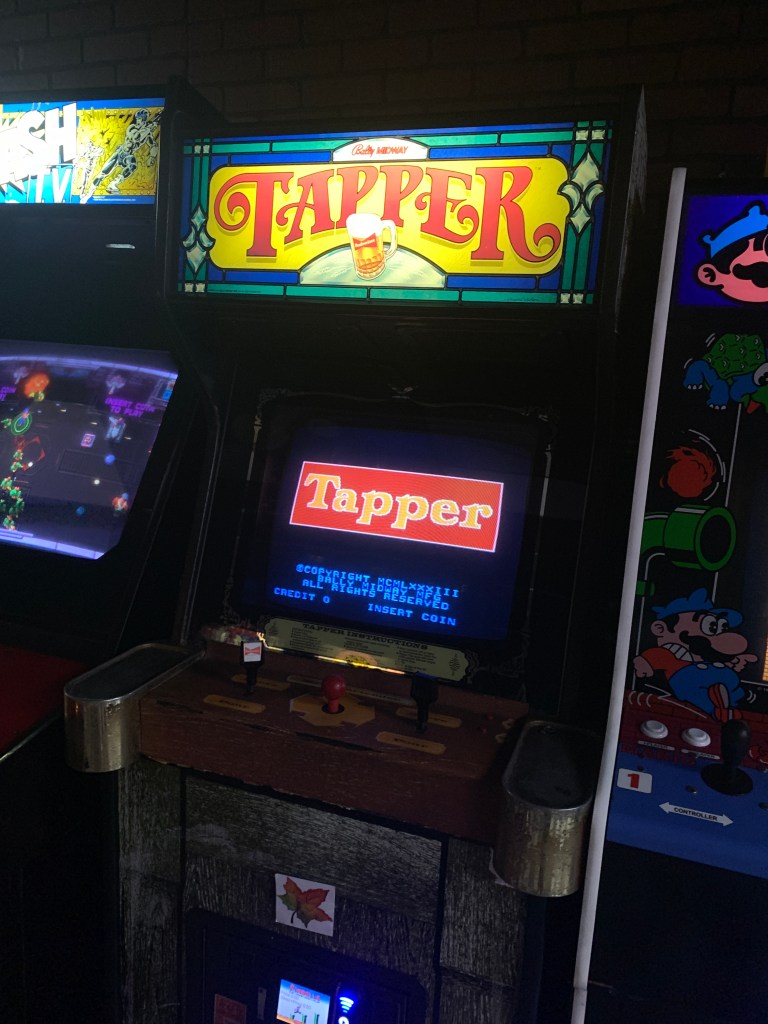
For my classic single-screen arcade game, I chose to play the lesser known gem titled, Tapper. Created by Midway, the narrative is rather simple; the player is a bartender who pours drinks for his patrons. The location of the action takes place in different bars that have different patrons for each establishment. When playing, the screen has four bars, stemming horizontally, each with a keg at one side and a door at the other. Customers shuffle in through the doors and move toward the kegs and the bartender. The player must pour drinks and slide them down the bar for the customers. After drinking the customers will move back towards the door and will either leave or slide their empty mug to the tap end of the table. Each patron served equates to points for the player. More points can be earned for picking up a random tip that can be left on the counter by a customer. The level is cleared when all customers have been served and have left the bar. After each level is cleared there is an additional bonus level in which six cans of beer are placed on the bar. A masked person then shakes five of the cans at random and shuffles them. The player then attempts to pick the unshaken can which awards bonus points upon a successful choice. Choosing any other can results in the bartender being covered in a spray of beer. The rules of the game are simple – one life is lost whenever any of the following occurs: the player fails to catch an empty mug before it falls off the keg end of the bar and breaks, a full mug slides to the door end of the bar without being caught where it falls
When I was deciding on what game to play I wanted to go with one that I had never played before. I chose Tapper because of how unique it’s controls looked. There was a joystick that moved horizontally and vertically with two tap handles on either side. I never read the directions but because of how the controls were shaped it was pretty easy to understand. This simple design as well as some of the game’s other characteristics clearly apply to Rouse’s shared traits of Classic Arcade games and allow for engaging, challenging, and enjoyable gameplay. While playing, some of Rouse’s traits were brought to mind. The concepts of no story as well as the various styles and strategies of gameplay dominated my thoughts while playing. Rouse wrote that classic arcade games were notorious for not having in-depth narratives, stating that “classic arcade game designers did not feel required to flesh out their game-worlds, to concoct explanations for why the player was shooting at a given target or eating a certain type of dot, and the games did not suffer for it”( Rouse, 465). In Tapper the developers were no different. You are a bartender. You serve drinks to customers to keep them happy. Anything more than that and it would be a distraction from the quick-paced chaos inside the bar.
Another concept of Rouse that stuck out to me was the different styles of gameplay that I undertook in my various playthroughs. The more I played, the more I changed my strategy. I developed what I think is a smart technique of counting the heads of the customers and sending the applicable number of drinks down all at once. Also I found that focusing on one lane until it is cleared while balancing the others until the preliminary lane is cleared worked well. My friend who I went had a different strategy, took more risks and had a more haphazard and seemingly unorganized approach to serving customers and actually ended up scoring more points.

 Austin’s Game Journal