Be yourself; Everyone else is already taken.
— Oscar Wilde.
This is the first post on my new blog. I’m just getting this new blog going, so stay tuned for more. Subscribe below to get notified when I post new updates.
Be yourself; Everyone else is already taken.
— Oscar Wilde.
This is the first post on my new blog. I’m just getting this new blog going, so stay tuned for more. Subscribe below to get notified when I post new updates.
For this week’s entry, I chose to play Journey, a game that relies on aesthetics – most importantly sound – to drive the narrative forward. In Journey the player voyages through an arid desert in which the soundscape exudes a lonely emptiness that is devoid of life. The environment makes up a large portion of the sound in-game. Overwhelming rushing of sand in the wind, silky waterfalls of sand, and the continuous crunching of your footsteps as you trek onward all reverberate throughout the game world. The other part of the soundscape is the scoring. This scoring, paired with the diegetic environmental sound, is what drives the narrative forward through the use of sensory phenomena (aesthetics) and audio cues.
The score of Journey contributes immensely to the emotion of the game. The loneliness of the visuals goes hand in hand with the beautiful echoes of string instruments that are carefully strung throughout gameplay. The score is a driving factor in Journey. Whenever the player completes an objective that is contributing to the progression of the game’s narrative; unique non-diegetic music accompanies the moment. These audio cues allow the player to understand that they are moving in the right direction. According to Karen Collins this type of sound is known as interactive non-diegetic sound. Collins describes this term as “sound events occurring in reaction to gameplay, which can react to the player directly, but are also outside the diegesis” (Collins, pg 126). While it could be argued that the score in some cases is diegetic with the chirping/gong sounds that the character makes, I am mainly discussing the score that is overlaying the entire game and can not possibly be diegetic – such as the orchestral instruments. The reasons why this is so effective in Journey is because of the effect of aesthetics. The satisfaction we receive from achieving something is being paired up with pleasing audio cues to cause an effective method of relaying to the player that they are doing something right in-game. In Simon Niedenthal’s writing, he describes there are three core meanings to game aesthetics. One of the three describes aesthetics as “…an expression of the game experienced as pleasure, emotion, formgiving…” (Niedenthal, pg3). By definition, the pleasurable emotions that I experienced due to the non-diegetic score that occurred whenever I would collect pieces of the scarf, or caused a reaction in the ruins, led me to keep continuing to progress in the game’s narrative. This reward of sensory pleasure in a vast sea of deserted wasteland for me was the major driving force in the game.
Works Cited
Collins, Karen. Game Sound: an Introduction to the History, Theory, and Practice of Video. Game Music and Sound Design. MIT Press, 2008.
Niedenthal, Simon. “What We Talk About When We Talk About Game Aesthetics.” DiGRA. Conference (2009).
In this weeks edition of my game journal, I chose Portal 2 for my post. I specifically chose this game because of it’s split-screen co-op mode that I had played in the past with my brother and what I would play with my current roommate presently. After settling in and playing for what seemed like the fastest hour ever, I had to tear myself away from the screen to write about the rules and resources of the game. The rules of Portal 2 are quite simple. Solve each level’s puzzle and move to the next course. Of course it is not as simple as that. According to Fullerton, “rules define game objects and define allowable actions by the players” (Fullerton, pg. 76). By this definition, Portal 2 utilizes it’s in-game environment and it’s controls as resources that define what the game world is, and what the player character can do inside of it. Fullerton describes a resource as something that has to have “utility and scarcity in the game system” (Fullerton, pg. 80). In Portal 2 the things that are most applicable to this definition are ammo for the portal gun, and the tiles that allow portal to be projected onto them. The portal gun, the item in which the entirety of the game revolves around, only has two shots – each for a single similarly colored portal. There is infinite use of these two shots; but if one were to try to create a third portal, one of the two that you created will disappear. This mechanic is what drives the game. In the co-op version, this create an essential use of teamwork. If you and your teammate ran out of portals and you aren’t where you need to be in the level… odds are you are not solving the level correctly. In this way the game creates a set of rules by using portals as resources (two or four if you’re playing co-op). The environment of the game also creates a unique resource. It is not possible to shoot your portals about willy nilly. There are specified tiles that are placed uniquely around each level. There are also only so many of these tiles in each level. This makes the player have to strategize how to best use them in order to fulfill the challenge. This type of “special terrain”, as Fullerton describes, is often used in map-based strategy games- such as Portal 2.
I would also describe patience as an essential resource while playing the game. It is key to not lose your cool when your partner simply will NOT place his portal in the right position. If you lose your cool, you lose the teamwork component of the co-op version of the game. However, if your patience resource is that low normally, it might be a good idea to stick to single person.
Works Cited
Fullerton, Tracy, et al. “Game Design Workshop: a Playcentric Approach to Creating Innovative Games.” Amazon, Morgan Kaufmann/Elsevier, 2008, http://www.amazon.com/Game-Design-Workshop-Playcentric-Innovative/dp/1138098779.
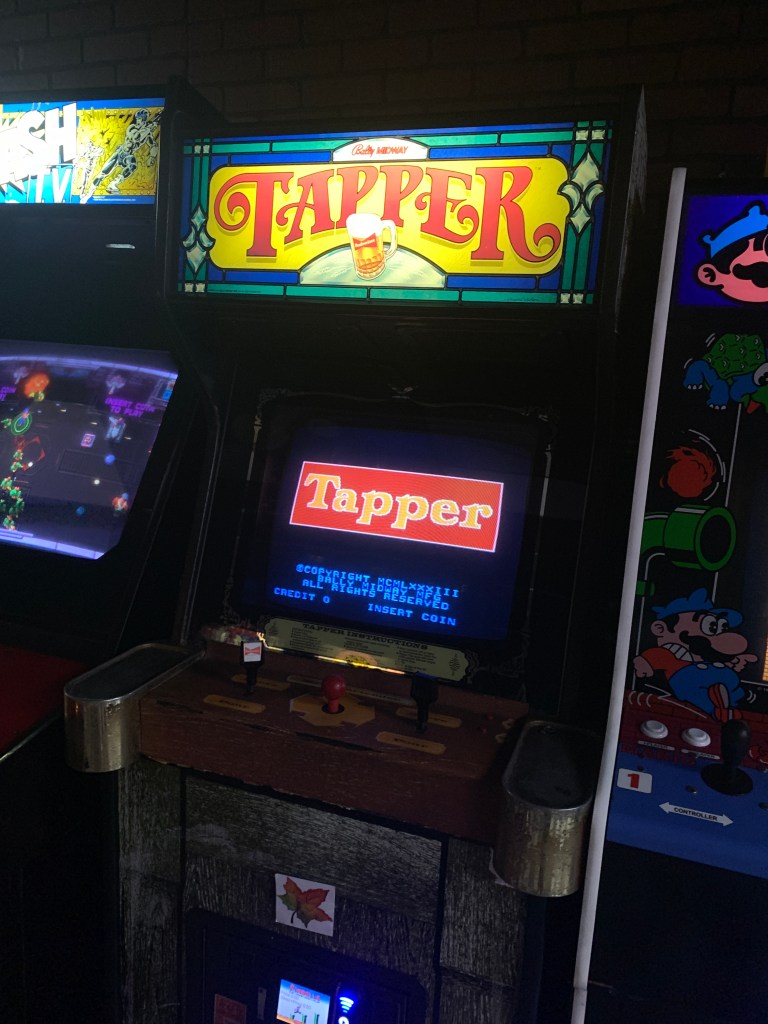
For my classic single-screen arcade game, I chose to play the lesser known gem titled, Tapper. Created by Midway, the narrative is rather simple; the player is a bartender who pours drinks for his patrons. The location of the action takes place in different bars that have different patrons for each establishment. When playing, the screen has four bars, stemming horizontally, each with a keg at one side and a door at the other. Customers shuffle in through the doors and move toward the kegs and the bartender. The player must pour drinks and slide them down the bar for the customers. After drinking the customers will move back towards the door and will either leave or slide their empty mug to the tap end of the table. Each patron served equates to points for the player. More points can be earned for picking up a random tip that can be left on the counter by a customer. The level is cleared when all customers have been served and have left the bar. After each level is cleared there is an additional bonus level in which six cans of beer are placed on the bar. A masked person then shakes five of the cans at random and shuffles them. The player then attempts to pick the unshaken can which awards bonus points upon a successful choice. Choosing any other can results in the bartender being covered in a spray of beer. The rules of the game are simple – one life is lost whenever any of the following occurs: the player fails to catch an empty mug before it falls off the keg end of the bar and breaks, a full mug slides to the door end of the bar without being caught where it falls
When I was deciding on what game to play I wanted to go with one that I had never played before. I chose Tapper because of how unique it’s controls looked. There was a joystick that moved horizontally and vertically with two tap handles on either side. I never read the directions but because of how the controls were shaped it was pretty easy to understand. This simple design as well as some of the game’s other characteristics clearly apply to Rouse’s shared traits of Classic Arcade games and allow for engaging, challenging, and enjoyable gameplay. While playing, some of Rouse’s traits were brought to mind. The concepts of no story as well as the various styles and strategies of gameplay dominated my thoughts while playing. Rouse wrote that classic arcade games were notorious for not having in-depth narratives, stating that “classic arcade game designers did not feel required to flesh out their game-worlds, to concoct explanations for why the player was shooting at a given target or eating a certain type of dot, and the games did not suffer for it”( Rouse, 465). In Tapper the developers were no different. You are a bartender. You serve drinks to customers to keep them happy. Anything more than that and it would be a distraction from the quick-paced chaos inside the bar.
Another concept of Rouse that stuck out to me was the different styles of gameplay that I undertook in my various playthroughs. The more I played, the more I changed my strategy. I developed what I think is a smart technique of counting the heads of the customers and sending the applicable number of drinks down all at once. Also I found that focusing on one lane until it is cleared while balancing the others until the preliminary lane is cleared worked well. My friend who I went had a different strategy, took more risks and had a more haphazard and seemingly unorganized approach to serving customers and actually ended up scoring more points.
This is an example post, originally published as part of Blogging University. Enroll in one of our ten programs, and start your blog right.
You’re going to publish a post today. Don’t worry about how your blog looks. Don’t worry if you haven’t given it a name yet, or you’re feeling overwhelmed. Just click the “New Post” button, and tell us why you’re here.
Why do this?
The post can be short or long, a personal intro to your life or a bloggy mission statement, a manifesto for the future or a simple outline of your the types of things you hope to publish.
To help you get started, here are a few questions:
You’re not locked into any of this; one of the wonderful things about blogs is how they constantly evolve as we learn, grow, and interact with one another — but it’s good to know where and why you started, and articulating your goals may just give you a few other post ideas.
Can’t think how to get started? Just write the first thing that pops into your head. Anne Lamott, author of a book on writing we love, says that you need to give yourself permission to write a “crappy first draft”. Anne makes a great point — just start writing, and worry about editing it later.
When you’re ready to publish, give your post three to five tags that describe your blog’s focus — writing, photography, fiction, parenting, food, cars, movies, sports, whatever. These tags will help others who care about your topics find you in the Reader. Make sure one of the tags is “zerotohero,” so other new bloggers can find you, too.

 Austin’s Game Journal